

Plan Your Trip
Everything international travellers need to know: visas, permits, getting here, getting around, weather, money and staying safe.
Visas & permits
Most international visitors need an Indian visa. Many nationalities can apply online for an e-Visa (tourist) through the official Government of India portal (indianvisaonline.gov.in). Apply well in advance and only use the official site. Nepalese and Bhutanese citizens do not need a visa.
No special permit is needed to visit Darjeeling itself. Foreign nationals do need a free Inner Line Permit (ILP) to enter Sikkim, issued at the Rangpo and Melli checkposts or online, and additional Protected Area Permits for some parts of Sikkim. Carry several passport photos and photocopies of your passport and visa.
Getting here
By air
The nearest airport is Bagdogra (IXB), about 70 km away, with flights from Delhi, Kolkata, Mumbai, Bengaluru and other cities. The drive up takes 3–3.5 hours by taxi; pre-paid taxi counters are at the terminal.
By train
New Jalpaiguri (NJP) is the main railhead, with overnight trains from Kolkata and connections from Delhi. From NJP take a taxi (3–3.5 h) or the Toy Train (7+ h).
By road
Shared jeeps and taxis run from Siliguri (near both NJP and Bagdogra) via Rohini Road or Hill Cart Road. Shared jeeps are cheap but cramped.
From Nepal & Bhutan
Overland travellers can cross from Kakarbhitta (Nepal) to Panitanki, or from Phuentsholing (Bhutan) to Jaigaon. Check that your visa type allows land border entry.
Getting around
Central Darjeeling is compact but very steep. Walking is the best way to explore the Mall, Chowrasta and Nehru Road, which are largely car-free. For sights further out, hire a taxi for a half or full day; rates for standard sightseeing circuits are fixed and hotels can arrange them. Shared jeeps to Ghum, Mirik, Kurseong and Kalimpong leave from stands near Chowk Bazaar.
When to visit
Darjeeling sits at about 2,045 m (6,709 ft). Even in summer, evenings are cool, so always pack a warm layer. Hotels may not have central heating; ask about heaters in winter.
| Season | Months | Weather | Good for |
|---|---|---|---|
| Spring | March–May | Mild, 8–18°C; some haze | Rhododendrons, first-flush tea, trekking |
| Monsoon | June–September | Heavy rain, mist, landslide risk | Lush scenery, fewer crowds, lower prices |
| Autumn | October–November | Crisp, clear, 7–17°C | Best mountain views, festivals, trekking |
| Winter | December–February | Cold, 1–9°C; occasional snow | Clear skies, quiet streets |
Money & costs
- Currency: Indian Rupee (INR, ₹). ATMs are on Laden La Road and around the town centre, but can run dry during holidays.
- Cards are accepted at larger hotels and shops; carry cash for taxis, small eateries and markets.
- Bargaining is normal at markets and stalls, but not in fixed-price shops.
- Tipping: 5–10% in restaurants is appreciated; tip guides and drivers at the end of a tour.
Health & safety
- Darjeeling is generally very safe for visitors, including solo and women travellers.
- Drink bottled or filtered water.
- Altitude sickness is rare at Darjeeling's height but possible on the Sandakphu trek. Ascend slowly.
- During the monsoon, landslides can block roads. Allow buffer time before flights.
- Strikes (bandhs) occasionally halt transport; your hotel will know.
- Emergency numbers: 112 (all emergencies), 100 (police), 108 (ambulance).
Practical information
| Time zone | Indian Standard Time, UTC+5:30 |
|---|---|
| Electricity | 230 V, 50 Hz; plug types C, D and M |
| Language | Nepali; English widely spoken; Hindi and Bengali understood |
| Phone & data | Tourist SIM cards available with passport and visa; coverage is good in town |
| Dialling code | +91 (India) |
Etiquette
- Greet people with 'Namaste' and palms pressed together.
- Remove shoes before entering temples, monasteries and homes.
- Walk clockwise around stupas and prayer wheels.
- Dress modestly at religious sites.
- Use your right hand to give and receive.
Places to experience it


Stories & guides

Introducing Our New Logo: A Fresh Identity for darjeeling.travel
In August 2024 darjeeling.travel adopted a new logo: a simple white line drawing of snow-capped peaks above a…
August 2024
Darjeeling in the Monsoon: Mist, Tea Gardens and How to Travel Safely
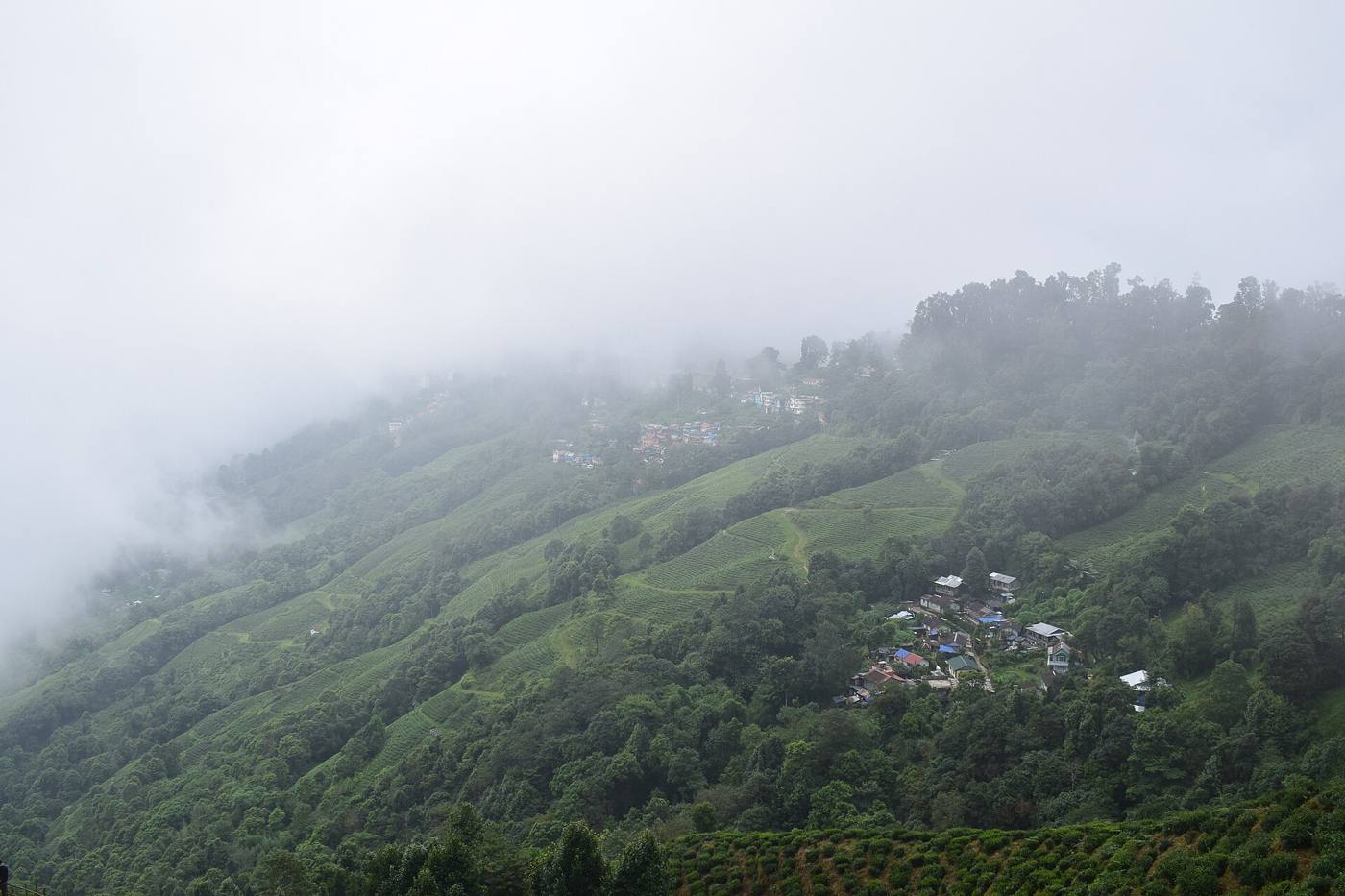
From June to September, Darjeeling disappears into cloud. The monsoon brings emerald tea gardens, waterfalls and empty…
July 2024
Discovering Darjeeling, the Queen of the Hills
Strung along a ridge above deep valleys, with Kangchenjunga on the horizon, Darjeeling has welcomed travellers for…